When Sigmund Freud was asked to define happiness, he gave this simple answer: “Work and love”. We all want to be happy at work, not only because we spend a significant part of our life working, but also because it is a source of meaning.
Great accomplishments, whether scientific breakthroughs, business triumphs, or the simple act of reaching a shared goal are accomplished primarily by and through people who have the drive to succeed and are committed to seeing a vision through to the end. These are the individuals you want to have as part of your organization or at least support them in reaching this level of engagement.
According to Gallup, global employee engagement is at 13% and this rate has been constant throughout the years. Similar Gallup studies have found the levels of engagement in Australia, the US, Japan, Germany, and the UK to be 18%, 12%, 9%, 17%, and 9% respectively.
There are a couple of reasons for these shockingly low rates, but the most important one is the lack of understanding of what employee engagement really is and what drives it. And because of that, companies end up trying all kinds of initiatives that don’t really hit the mark.
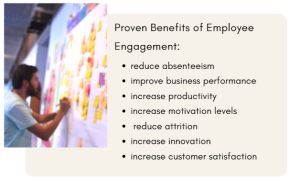
In this blog post, we’ll dive into the scientific definition of employee engagement, share some of the amazing benefits that it can bring to your organization, and best of all, we’ll give you some practical strategies that you can start using in your workplace right away. By the end of the post, you’ll be well on your way to creating a happier, more motivated, and more productive team. So, let’s get started!
Defining Employee Engagement
Employee engagement is a term that is commonly used in the world of HR, but it’s often misunderstood. Employee Engagement has been defined in multiple ways, such as “passion for work”, feeling positive about your job, being prepared to go the extra mile and more! All of these sound very familiar to each other, yet they’re very distinct from what engagement really is.
Employee engagement is not the same nor a synonym for job satisfaction or job motivation.
Employee engagement is a much broader and deeper concept than “satisfaction” or “motivation” alone. It is, after all, possible to feel motivated by one’s work, without feeling any great sense of commitment to one’s organization—commitment being an important component of engagement. Satisfaction elements such as competitive pay, employee perks, or technology tools are not foundational drivers of employee engagement. Put another way, as with satisfaction, engagement connotes positive emotions towards the job and the organization, but the latter also involves the exertion of high levels of energy and activation while performing tasks. So while satisfied individuals have positive emotions about their jobs, engaged employees also show high levels of activation on that job.
Employee engagement is not the same nor a synonym for job involvement.
Job involvement refers to the judgment employees make about the degree to which jobs can satisfy their needs and are concerned with and preoccupied with their jobs. As with satisfaction and commitment, while involvement may be a component of engagement, engagement is wider in scope with engaged employees focusing on both work and organization, while involved employees focus only on job-related tasks. Engagement is a two-way relationship between the employees and their employer; a relationship that gives engaged employees the element of business awareness that is not necessarily evident in satisfied, committed, or involved employees.
Employee engagement is not the antithesis of employee burnout.
Another false perception of organizations considers engagement as the antithesis of burnout. This approach is particularly problematic because it assumes that low levels of burnout equal high levels of engagement. In fact, employee engagement and burnout are not mutually exclusive. Many studies have shown that highly engaged employees are more prone to feeling stressed and burned out if engagement initiatives don’t take employee well-being and mental health into consideration.
Employee Engagement Done Right
At Work Unlocked, we approach employee engagement as defined by research in positive psychology. According to positive psychology, engagement is a strong predictor of well-being enabling employees to fully immerse themselves in their work. This strengths-based approach has helped our clients sustainably increase and maintain high employee engagement levels, even at times of adversity.
Hence, we define employee engagement as:
The harnessing of organizational members’ selves to their work roles; in engagement, people employ and express themselves physically, cognitively, and emotionally during role performances (Kahn, 1990).
In other words, engaged employees fully immerse themselves in their work physically, cognitively, and emotionally. To achieve this level of engagement, three psychological conditions must be met:
- Psychological Meaningfulness: an individual’s experience of feeling valuable, useful, and worthwhile while finding a sense of harmony and completeness within the occupational environment.
- Psychological Safety: an individual’s belief that one can freely express themselves at work without being fearful of negative consequences.
- Psychological Availability: an individual’s available cognitive, physical, and emotional resources, that are necessary to engage with their work.
In other words, an employee will determine whether to engage with their work after subconsciously considering:
- How meaningful is it for me to bring myself into this role?
- How safe is it to do so?
- How available am I to do so?
Now that you’re clear about what employee engagement is and what drives it, let’s take a look at some key strategies and best practices you can implement right away even if you have limited organizational resources.
Employee Engagement Activities and Strategies
Improving employee engagement is not a one-time event, but rather an ongoing process that requires a commitment from leaders and HR professionals. Here are some proven employee engagement strategies that you need to include in your employee engagement program:
Job crafting: work meaningfulness through task meaningfulness.
The first step in making work more meaningful is to look at the tasks themselves. At job crafting, you look for ways to sculpt someone’s job role without actually changing the tasks. It’s a bottom-up approach to job design in which employees are encouraged to craft their work responsibilities to be fulfilling and better fit to their needs and competencies.
For example, maybe one person in your team enjoys interacting with customers on social media, but your current social media manager would rather focus on new content. Shuffling job responsibilities around can result in everyone doing more of what they enjoy every day.
- Hold a Job Crafting workshop with your team. To learn more and get access to our workshop guide & templates, check out our Job Crafting Toolkit.
- If job crafting isn’t an option due to the nature of the job, you can start by having feedback discussions with your employees and identifying how you can try to even slightly adjust the job responsibilities.
Introduce regular feedback discussions to maximize psychological safety.
Employees are more committed to supervisors who listen to them and provide regular feedback. In fact, the most important psychological safety factor for employees is receiving feedback from their supervisor, followed by the belief that the supervisor actively listens to his/her employees.
- Introduce mandatory monthly “Let’s Talk” 1-on-1 meetings between managers and employees aiming at exchanging feedback on current projects and discussing what the employee needs to continue progressing.
- Introduce mandatory quarterly “Success Talk” 1-on-1 meetings between managers and employees aiming to discuss career progression and skills development. The aim is to ensure that employees continuously feel supported, appreciated, and well.
Build good co-worker relationships to increase support and psychological availability.
There are many ways you can go about building good relationships with and amongst employees. Here are some practical strategies:
- Learn more about the interests and circumstances of your employees. This provides opportunities to find common ground for authentic conversations and creates the basis for building a genuine relationship.
- Create opportunities for positive emotions/interactions within the team. Positive and pleasant conversations with coworkers promote trust and build support networks and employee cohesiveness.
- Create opportunities for team socialization with the help of team events.
- Implement team-building activities. Get access to proven and simple exercises by downloading our Trust & Team-Building Toolkit.
Got questions or need support with creating a healthier workplace? Then I would love to hear from you! E-Mail me directly at stavy@workunlocked.com or book a free 30-minute call with me!
Have a great day at work!